
5 Minimalist Street Photography Tips That Changed How I See the Street
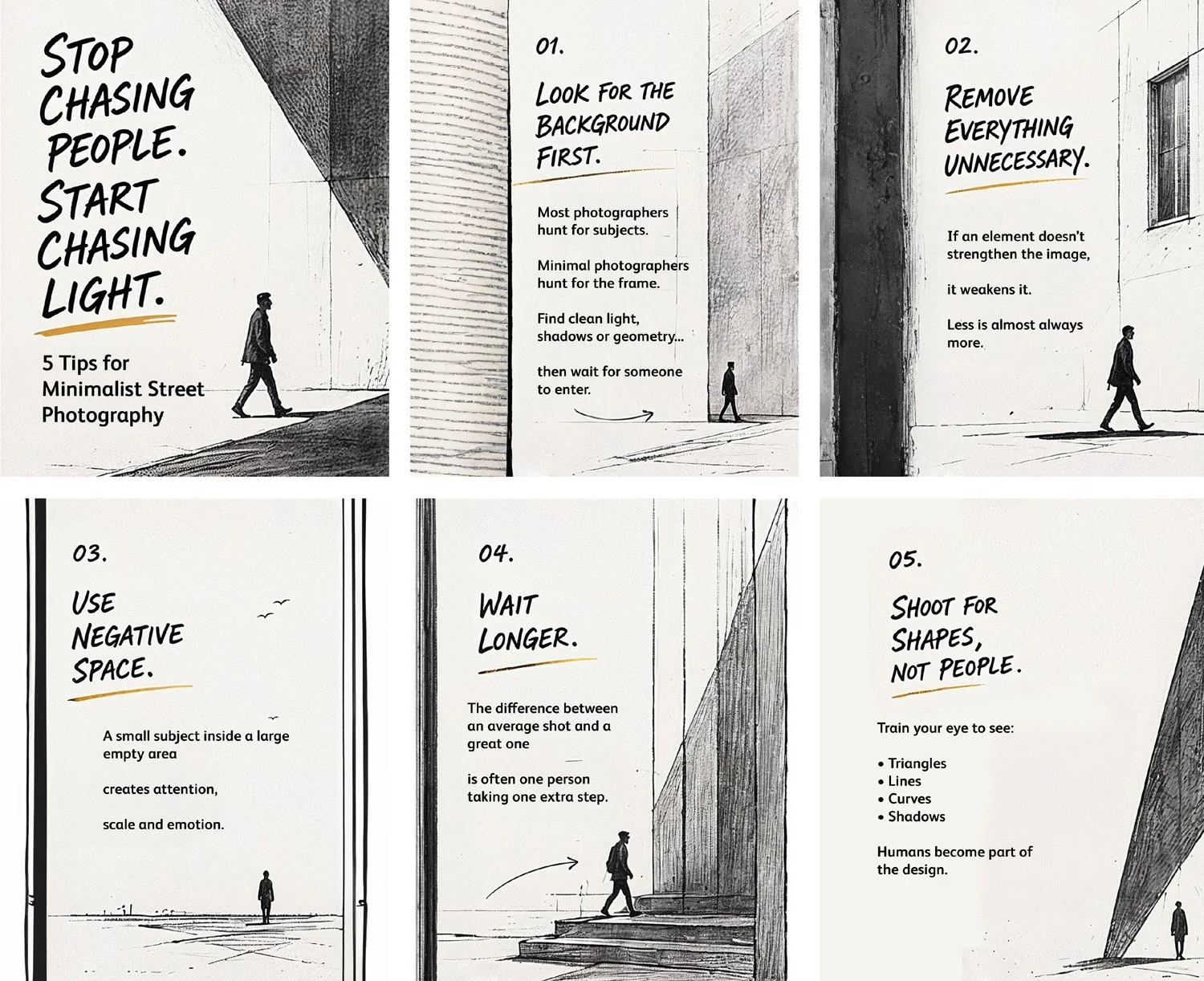
When most people begin street photography, they focus on finding interesting people.
A person with an unusual outfit.
A striking face.
A dramatic expression.
While subjects matter, I discovered that the strongest street photographs rarely begin with the person.
They begin with the frame.
The biggest improvement in my photography came when I stopped chasing people and started chasing light, shadows, geometry, and empty space. Instead of reacting to whatever happened in front of me, I learned to build the scene first and wait for the right moment to complete it.
If you're interested in minimalist street photography, these five principles can help you create cleaner, more impactful images.
1. Look for the Background First
Most photographers search for a subject and then try to build a composition around them.
Minimalist photographers often do the opposite.
Before a person enters the frame, look for interesting architecture, clean walls, dramatic shadows, reflections, or geometric shapes. Once you've found a strong visual foundation, position yourself and wait.
The photograph often already exists—you are simply waiting for the right person to walk into it.
This approach transforms street photography from a reactive process into a deliberate one.
2. Remove Everything Unnecessary
One of the most important questions I ask myself before pressing the shutter is:
"What can I remove?"
Minimalism is not about having less for the sake of less. It's about removing distractions so the viewer can focus on what matters.
Pay attention to:
Unnecessary signs
Distracting backgrounds
Bright objects near the edge of the frame
Extra people that compete with your subject
A simple composition often has a stronger emotional impact than a complicated one.
When in doubt, simplify.
3. Use Negative Space
Negative space is one of the most powerful tools in minimalist photography.
By placing a small subject within a large empty area, you create a sense of scale, isolation, calmness, or even tension.
Many photographers feel uncomfortable leaving large areas of their frame empty. However, those empty spaces often become an important part of the story.
The emptiness gives the subject room to breathe.
It allows the viewer's eye to settle and engage with the image.
Sometimes what isn't in the frame is just as important as what is.
4. Learn to Wait
Patience is often the difference between an average photograph and a memorable one.
Once you've found an interesting composition, resist the temptation to move on too quickly.
Wait.
Observe.
Watch how people move through the space.
A single step can completely change a photograph.
The perfect silhouette, gesture, or position may only appear for a fraction of a second, but those moments are often worth waiting for.
Many of my favourite images happened because I stayed five minutes longer than everyone else.
5. Shoot for Shapes, Not People
One of the most effective ways to improve your eye is to stop thinking about people and start thinking about shapes.
Look for:
Triangles
Lines
Curves
Patterns
Shadows
Symmetry
When these elements work together, people become part of the design rather than the sole subject.
This creates photographs that feel cleaner, stronger, and more timeless.
The viewer begins to experience the image as a visual composition rather than simply a record of a person walking down a street.
Final Thoughts
Minimalist street photography is not about finding less. It is about seeing more clearly.
The streets are full of visual noise. The challenge is learning how to simplify that noise into something meaningful.
The next time you head out with your camera, try a different approach.
Don't look for people.
Look for light.
Look for shadows.
Look for geometry.
Build the frame first, then wait for life to enter it.
You may be surprised by how dramatically your photographs improve.
Want to Develop Your Own Eye for Minimalist Street Photography?
I offer private 1-to-1 street photography workshops designed for photographers who want to improve their composition, learn to see light differently, and develop a stronger visual style.
During the workshop, we'll explore real locations, analyse scenes together, discuss timing and composition, and review your images to help you build confidence and consistency in your photography.
To learn more or book a session, visit Sannib.com or get in touch directly.