
People and Buildings: How to Photograph Architecture Without Losing the Human
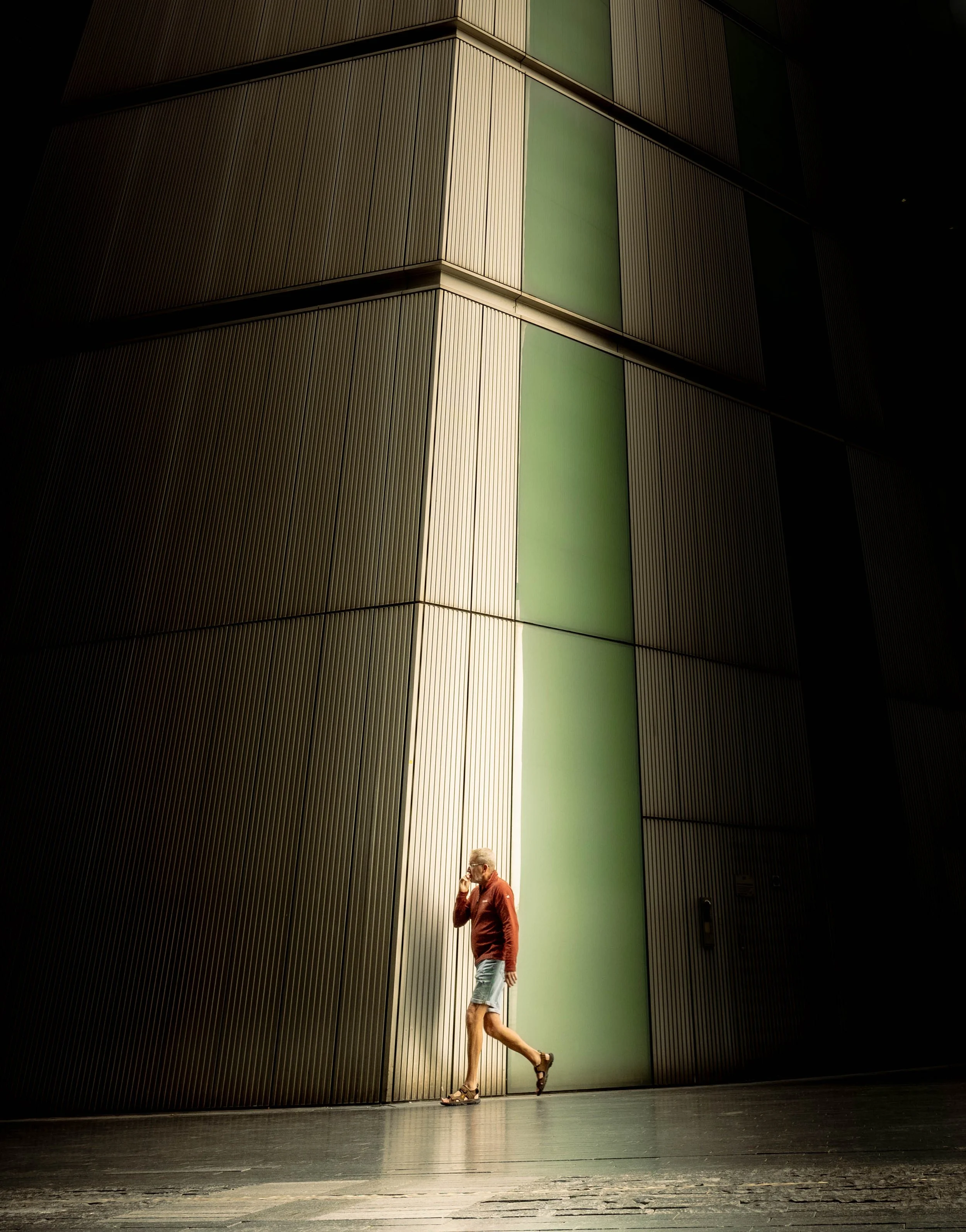
There is a long-standing tension in urban photography between two impulses: the desire to photograph the city as pure form — clean, geometric, abstract — and the reality that cities exist because people inhabit them. Remove the human figure and you have documentation. Keep it, and you have the possibility of something much more resonant.
The most compelling architecture and street photography holds both at once. Buildings and people in a relationship — one giving meaning to the other.
Here's how that relationship actually works, and how to build it into your images.
---
Start With the Architecture, Not the Person
This feels counterintuitive, especially if you come from a portrait or reportage background. But in street fine art photography, the scene comes first.
Before looking for people, read the location. What is the light doing? Where does the geometry create tension or depth? Are there leading lines, repeating forms, shadows that divide the frame? Is there a natural point — a gap, a threshold, a patch of light — where a human figure would complete rather than clutter the composition?
You are building a stage before the actor arrives. This is the fundamental shift in how you approach this kind of photography, and it changes everything about how you move through the city.
---
Understanding Scale: Why One Person Is Worth a Thousand
Architecture photography without people often fails at communicating scale. We look at an image of a large building and intellectually know it's large, but we don't feel it. One small figure at the base of a tower changes that completely.
But scale is more than just size. A human figure in an architectural photograph also communicates time — this is not a ruin, not a rendering, but a living space. It communicates use — this building exists in relationship to human bodies moving through and around it. And it communicates proportion — the relationship between the built and the bodily, which is one of the fundamental tensions of modern urban life.
The smaller the figure relative to the architecture, the stronger this effect. A lone person dwarfed by a glass façade becomes a statement about the scale of contemporary ambition — or its indifference to the individual. You don't need to plan this consciously. You need to be aware of it, so you can feel when it's working.
---
Positioning: Where You Stand Changes Everything
In most photography, the question is where to point the camera. In architecture and street fine art photography, the more important question is where to stand.
Your position determines the relationship between foreground and background, between near and far elements, between the building's geometry and the human figure within it. Move two metres to the left and a figure that was floating in empty space now sits precisely within a frame created by two vertical columns. Step back five metres and the same figure, previously dominant, becomes a small mark in a much larger architectural statement.
This requires time — standing somewhere and thinking before you shoot. Watching how people move through a space and mentally testing whether their movement path will create what you're looking for. It requires patience, which is perhaps the most underrated skill in fine art photography.
---
Colour vs. Black and White: A Deliberate Choice
Both approaches serve street fine art photography, but they do different things.
Black and white strips the city back to its bones: form, light, shadow, texture, geometric structure. It removes the sometimes distracting information of colour and forces the viewer to engage with the image's underlying composition. For architecture, where the interest is often in structure and geometry rather than material, black and white can be powerfully clarifying.
Colour, on the other hand, adds information about material, atmosphere, and time of day. The warm orange of evening light against a grey concrete surface. The cool blue of a steel-clad building on an overcast London morning. The green tint of glass reflecting a sky. Colour can deepen the emotional register of an image in ways that monochrome cannot.
The question is not which is better — it's which serves this particular image. Developing that judgment is part of developing your own visual approach.
---
Working With What the City Gives You
Street fine art photography is a practice of attentiveness and adaptation. You cannot control the weather, the light, or who walks through your frame. You can control your positioning, your patience, and the quality of your observation.
This means accepting that a location you've identified as promising might not yield an image today. The light isn't right, or the people moving through the space aren't creating the relationships you're looking for. This is not failure — it's the nature of the practice. The photographer who returns to the same corner ten times in different light and weather is doing something closer to what a painter does in a studio: a sustained, repeated engagement with a subject that deepens over time.
London is a city that rewards this kind of commitment. Its architectural variety is extraordinary. Its light, changing rapidly under Atlantic weather systems, never offers the same scene twice. Its streets contain, in a single block, the ancient and the contemporary, the intimate and the monumental.
The city has more to give than any single session can contain. The practice is learning how to receive it.
---
Sannib leads private 1-to-1 architecture and street photography workshops in London. All levels welcome. [sannib.com](https://www.sannib.com)